


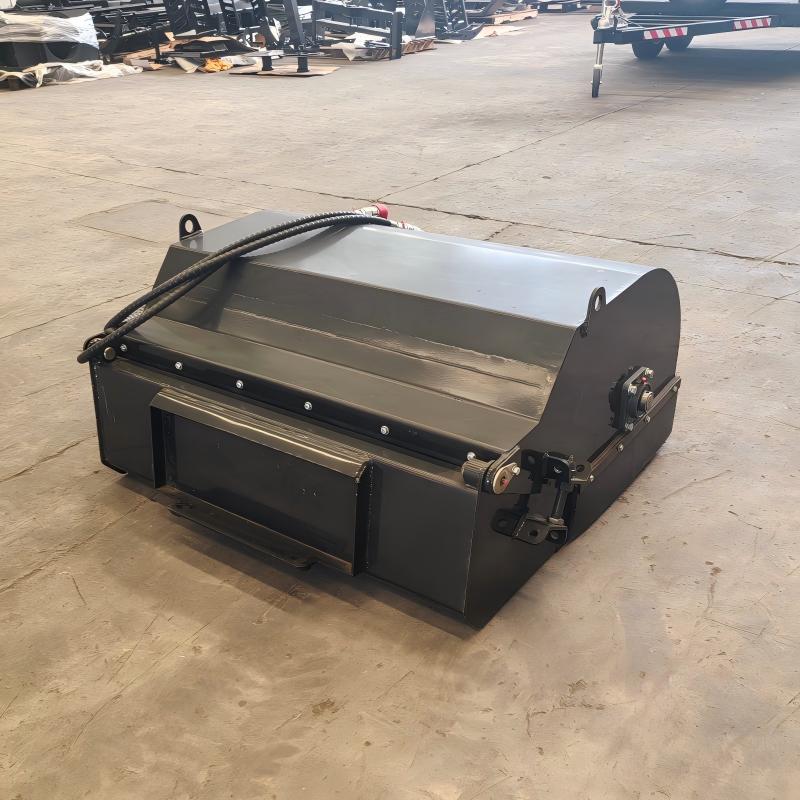
This skid steer pick up sweeper is a closed-loop cleaning attachment that sweeps, vacuums and collects in the same pass. A side brush feeds debris under the rotating main brush, the airflow around the brush lifts fine dust off the surface, and everything is drawn into a sealed hopper instead of being thrown out in front of the machine. What is left behind is a surface free of litter, leaves and the fine grey dust that a conventional broom only moves around.
It is a loader attachment in the fullest sense: the carrier machine supplies the power and the operator works the cleaning pass from the cab, so a site does not need to bring in a dedicated sweeper, a second crew or a towed unit.
Facility managers, contractors, property maintenance teams and rental operators are the usual buyers, because they are the people who have to keep a surface clean while also keeping dust out of the air. Each unit is assembled as one complete attachment — brush carrier, hydraulic drive and hopper — by a skid steer sweeper attachment manufacturer, and arrives ready to mount on a skid steer loader.
| Specification | Detail |
|---|---|
| Mounting | Standard skid steer quick-attach plate |
| Drive | Carrier machine auxiliary hydraulic circuit |
| Sweeping element | Hydraulic-driven brush carrier with heavy-duty bristles |
| Collection | Sealed debris hopper |
| Debris handled | Fine debris, dust, leaves and light material |
| Surfaces | Paved and unpaved |
| Wear parts | Replaceable bristles and seals |
| Housing | Hooded steel housing with a bolt-on side flange |
| Couplers | Flat-face hydraulic couplers with protective caps |
| Cleaning width | Wide cleaning path per pass |
| Working environments | Indoor and outdoor |
Cleaning starts at the edge. A hydraulic-driven side brush works the corner or kerb line and pushes litter into the path of the main brush, so the operator does not have to make a second hand pass along walls and kerbs.
The main brush then does two jobs at once. Its rotation lifts material off the surface while the airflow around it carries lightweight dust into the housing. Coarse litter and fine dust travel together into the collection chamber rather than being flicked out of the front of the machine, and the sealed hopper holds everything until the run is finished.
The drive is simple by design. A compact hydraulic motor turns the brush carrier, and the attachment takes its power from the carrier machine's auxiliary hydraulics — there is no engine to refuel, no battery routine and nothing to start separately. The hoses run to flat-face couplers with protective caps, and the brush carrier and motor sit behind a bolt-on side flange that opens for inspection without stripping the attachment down.
When the run is complete, the hopper is emptied at a designated point rather than in the middle of the area that has just been cleaned.
The attachment is built around the mounting interface a skid steer loader already carries, so it goes onto the machine that is on site instead of requiring a dedicated carrier. It runs from the loader's auxiliary hydraulic circuit through commonly used couplers, which is how the same unit can be shared across a fleet of mixed machines.
Hydraulic flow is the one detail worth checking properly. Auxiliary flow ratings differ between loader models and sizes, and a machine at the lower end of the range will work the attachment differently from a larger one. Tell us your loader's flow rating and the coupler style it uses, and we will confirm the configuration before the sweeper ships.
For rental operators and contractors running several loaders, that common interface means one sweeper can move to whichever machine is free that day. The unit goes on and comes off like the loader's other attachments, so it takes its place in the normal rotation rather than needing special handling or a second operator.
Two practical notes for the operator. A front-mounted sweeping attachment changes the way a loader feels compared with bucket work, so allow for the extra front weight and take the first passes at a moderate speed. And check the couplers themselves, not only the flow figure — worn or mismatched fittings are the most common reason a hydraulic attachment underperforms.

Post-grading construction pads.
After grading, cutting or demolition work, an operator runs the sweeper over the pad and the access route to clear the dust and crumbs before the next trade moves in, rather than putting a labourer on a broom and shovel.
Interior warehouse aisles.
Dust that a broom pushes under racking is lifted and collected instead, which keeps stock, pallets and fire routes cleaner in a busy picking area.
Multi-storey car park decks.
The loader works deck by deck and around columns and parked cars, and the sealed hopper means the fine dust is not blown across the neighbouring vehicles.
Food plant and loading yards.
Where hygiene and air quality are watched, the closed system collects the fine material that would otherwise settle back onto surfaces or drift in through open doorways.
Hospital, clinic and school frontages.
Entrance roads and pathways cleaned early in the morning or between classes, where a visible dust cloud next to the public would be unacceptable.
Municipal walkways and cycle paths.
Grit, leaves and litter collected in one run — this is where a closed sweeper attachment for road cleaning earns its keep, emptying the hopper at a yard or collection point rather than in the street.
Equipment yards before handover.
Dealers and contractors tidy their own yard and the customer's access before a machine leaves, using the same attachment that will clean the customer's site afterwards.
On a construction site, dust is produced by almost every operation: cutting, grinding, grading, demolition and vehicle movement. It settles on the pad, on the access route and in the areas where the next trade is about to start, and an open broom simply lifts it into the air again.
Running this attachment before a handover, before an inspection or before an adjacent work front opens puts that material in the hopper. For the site manager it is a straightforward answer to a dust-control question, and it reduces the call-backs that follow dust drifting onto neighbouring property.
Contractors also get the benefit of using equipment that is already on site. There is no street sweeper to hire, no separate crew to organise and no transport cost to bring a cleaning machine in; the cleanup is slotted between the loader's other tasks and the loader goes back to work.
For a rental fleet, the effect is on utilisation. A sweeper that fits the loaders already on hire turns a general-hire machine into a cleaning machine on request, which opens up handover cleaning, tidy-up work and municipal contracts, and lets the same unit be issued to a different site each week.
Buying one sweeper is a straightforward decision; buying for a fleet is where the design detail pays off. The attachment is built around the mounting and hydraulic interfaces a skid steer loader already has, so adding one does not mean adding a special carrier or a separate power pack.
If you are standardising across several loaders, order the same configuration for each machine so any operator on the fleet can work the attachment in the same way. Tell us at the first order that more units are planned for rental or resale, and we will quote the follow-up units to the specification you have already approved.
Maintenance is the other half of the purchase decision. Bristles and seals are service items with a place in a routine maintenance line, which is easier to budget across a fleet than replacing complete attachments, and the build is modular so a brush or hopper part can be serviced without withdrawing the whole unit from the schedule.
One more point for buyers who order in volume: the skid steer sweeper attachment manufacturer builds this unit to a single specification, so a fleet or a dealer network receives the same attachment rather than a batch of variations.
If cleaning equipment has to satisfy dust or environmental requirements in your market, raise it during the enquiry and we will confirm what documentation can be supplied with the order. And where the sweeper is bought to rent out or resell, the closed version answers the questions an open broom cannot — indoor work, hygiene environments and sites with dust restrictions.
Deployment is deliberately simple. The sweeper is brought out when a surface needs cleaning and removed when the job is done, so cleanup is scheduled around the site rather than the site around a cleaning machine.
Operators need very little introduction. There is no engine to start, no fuel or battery routine and no separate control panel; the attachment is worked from the controls the loader operator already uses, which keeps handover time short when a sweeper passes between shifts, machines or depots.
The layout suits that turnover. Components are arranged for maintenance rather than sealed into a disposable unit, so a sweeper coming back from a hire can be emptied, checked and returned to service as part of the normal turnaround, and the parts that need attention are the ones an operator or a workshop can reach.
It also fits the rhythm of mixed work. The same loader that is controlling dust on a paved yard can go straight back to general duties, with no extra trailer, no second operator and no separate maintenance regime to manage alongside the rest of the fleet.
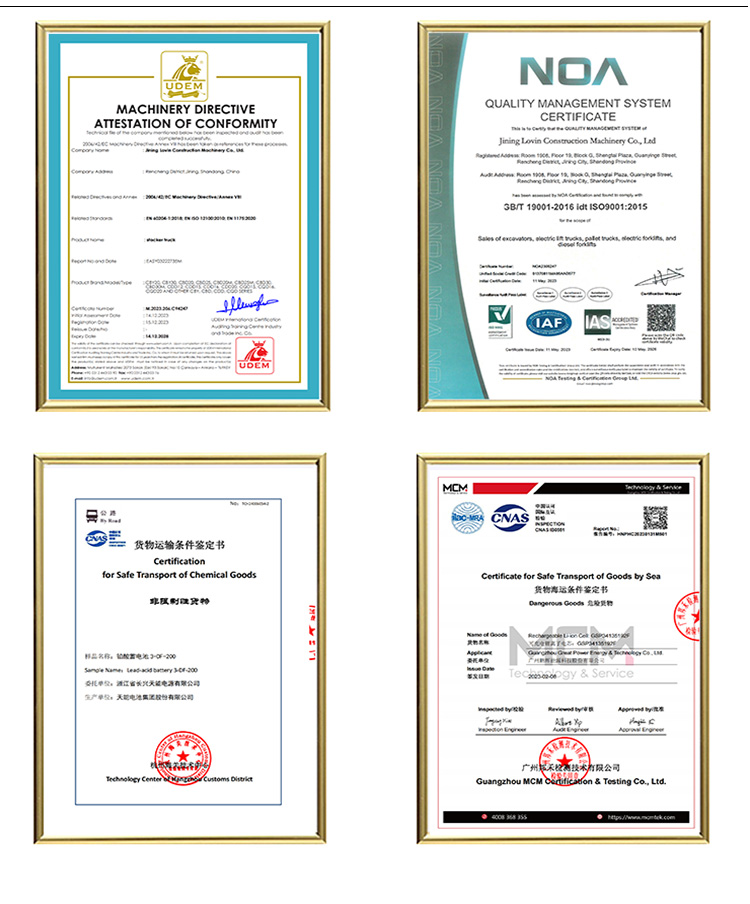
Lovin (Jining Lovin Construction Machinery Co., Ltd.) has supplied machinery buyers since 2017 as a distributor, sourcing through authorised channels and a verified supplier network. One order can cover the machinery mix your customers ask for and leave as a single consolidated shipment. Stocked items dispatch within about 7 days; lead times are confirmed against availability at enquiry, and busy-season schedules are agreed with suppliers in advance. OEM and customised builds follow the same route, and spare and wear parts stay supported after delivery. We export to Europe, South America, the Middle East, Australia, New Zealand and Russia.
It collects fine debris, dust, leaves and light material on paved and unpaved ground — asphalt and concrete yards, warehouse floors, car park decks, walkways and compacted construction pads. Because everything goes into the sealed hopper, the cleanup stays controlled on both types of surface, which is what makes it a practical closed sweeper attachment for road cleaning as well as yard and interior work.
In most cases, yes. This skid steer pick up sweeper uses the standard quick-attach mounting system and the commonly used hydraulic interfaces found on skid steer loaders, so it goes onto the machine you already run. Flow ratings and coupler styles differ between models, so send us your loader details and we will confirm the configuration before the unit ships.
The attachment combines the sweeping action with integrated vacuuming and a sealed debris hopper, so the dust lifted at the brush is captured instead of being thrown out in front of the machine. In practice there is no trailing dust plume and far less material settling back onto nearby surfaces, which is why the closed version suits sensitive indoor and outdoor environments and sites that monitor airborne particulate.
Yes. The side brush moves litter into the path of the main brush, and the airflow around the main brush lifts the lightweight dust a broom would normally leave behind. Coarse material and fine dust end up in the same hopper, so a single run usually finishes the surface.
Empty the hopper before it packs full, clear any string or wire wrapped around the brush carrier, and check the bristles and hopper seals for wear each time the attachment is serviced. That short routine is what keeps sweep quality and dust containment steady, and worn bristles and seals are replaceable rather than a reason to take the unit out of service.
Yes. The sealed collection system is what allows it to work inside a warehouse, production hall or food plant without filling the space with dust, and the same unit handles car parks, yards and construction pads outside. The mounting and the controls do not change with the location.


