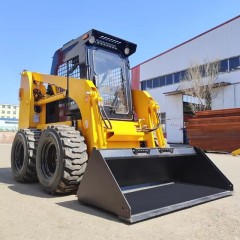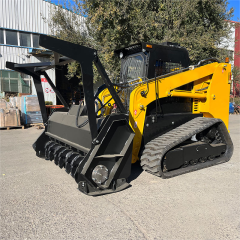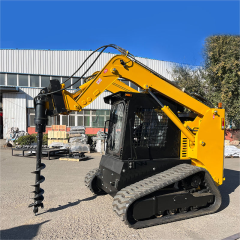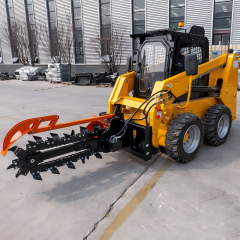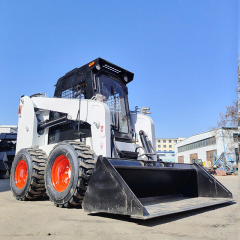
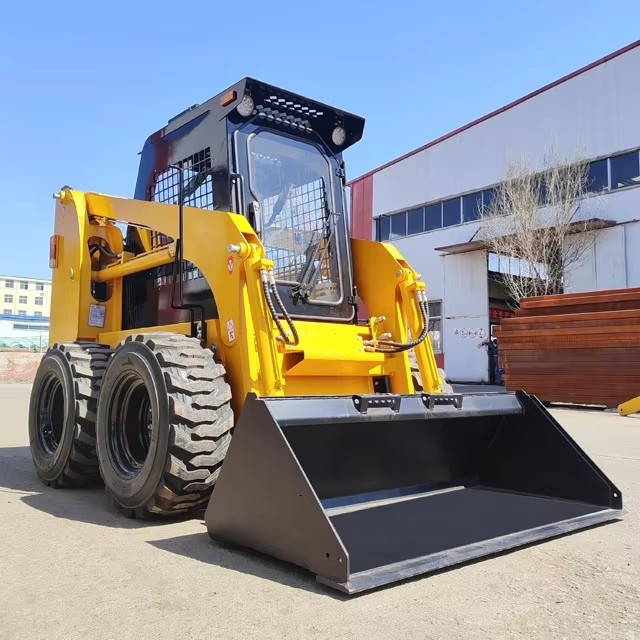
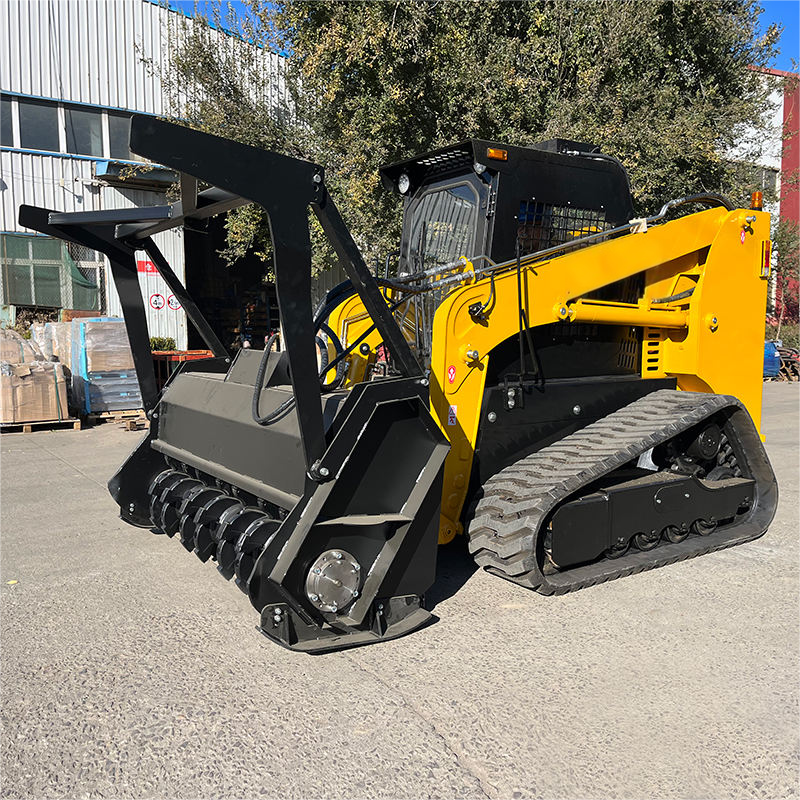
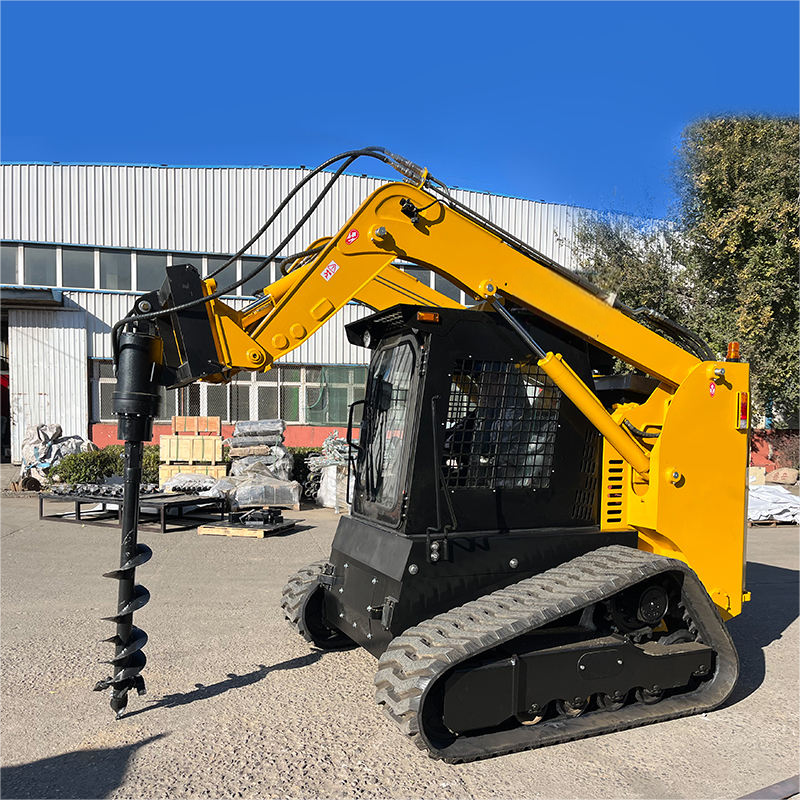
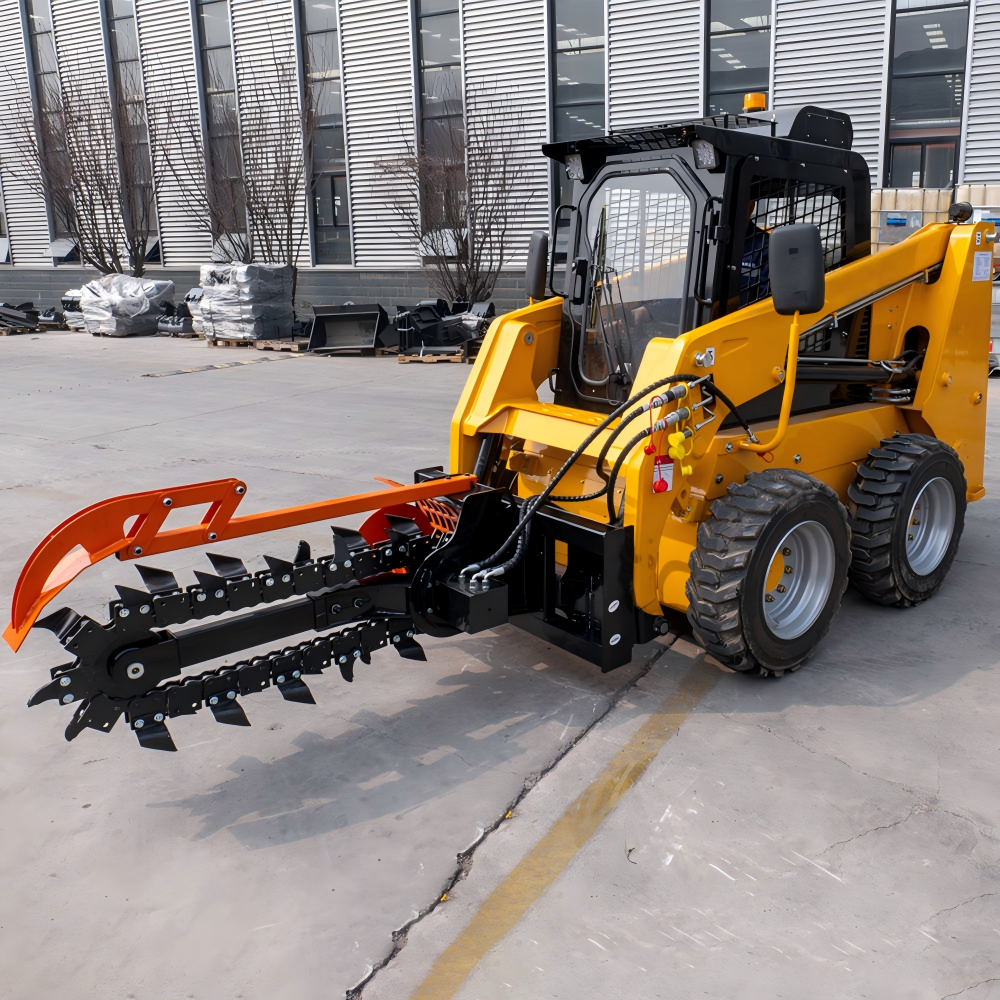
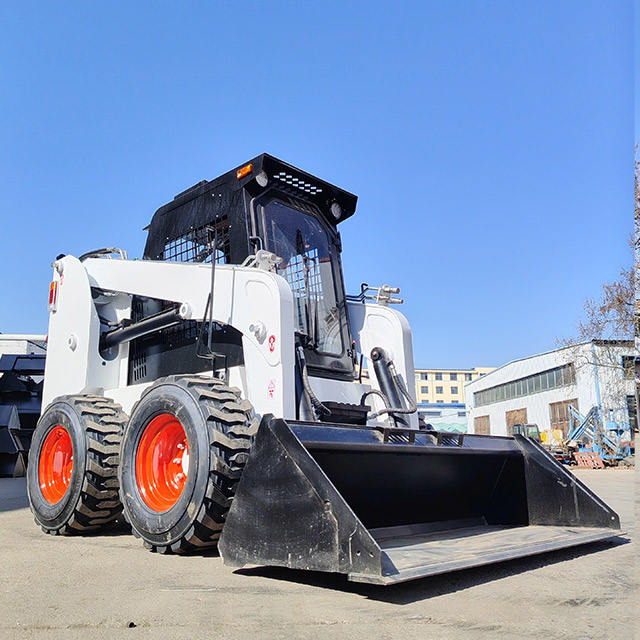
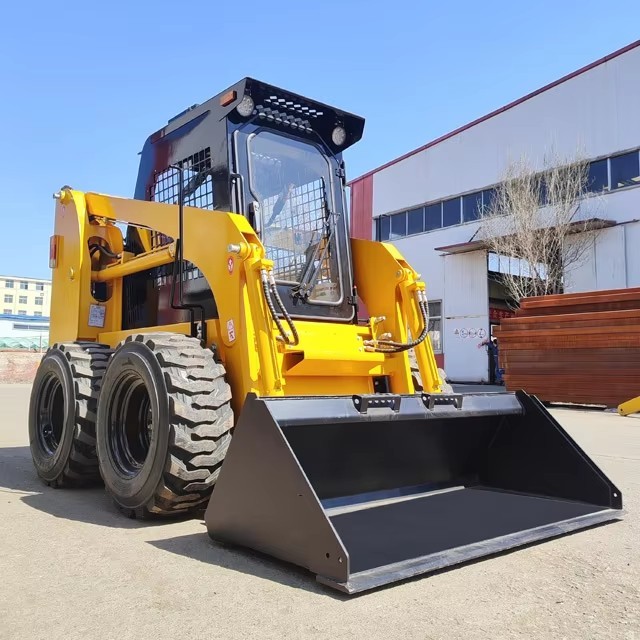
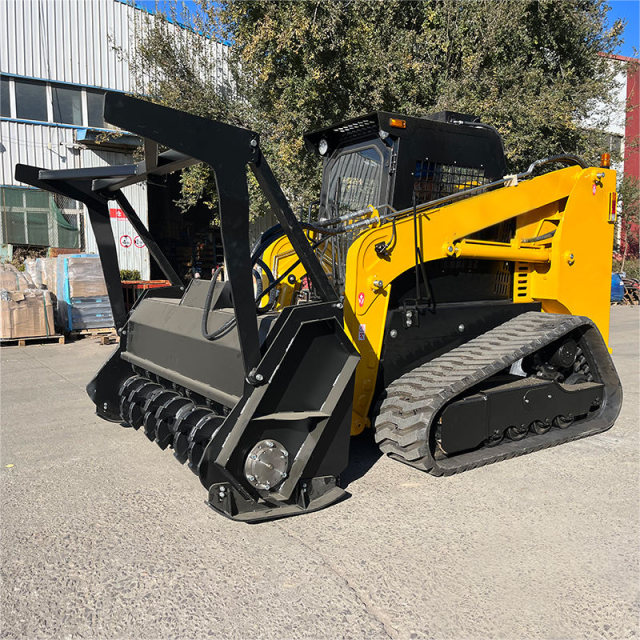
As a skid steer attachments manufacturer, Lovin supplies a broad attachment range for compact loaders — the tools that turn one carrier machine into a working fleet. A skid steer is only as useful as what is bolted to the front of it, and most owners buy the loader first and spend the next few seasons adding to it.
The logic is simple: the loader supplies the engine, the hydraulics and the operator, and the attachment supplies the job. Swap the tool and the same machine digs, lifts, cuts, mills, sweeps or pushes snow. A contractor can break out a sidewalk in the morning and load the debris with the same machine after lunch, while a farm can unload feed, replace fence posts and clean out the barn without hiring anything in.
Zero-radius skid steering is what makes that work on real sites. The loader pivots inside its own length, so it reaches barn aisles, crowded building pads, car parks and narrow sidewalks where a larger machine cannot go. Radial or vertical lift arms, maintenance-free Tier 4 Final engines and joystick controls have turned the current generation of loaders into a grease-and-go tool rather than a workshop project.
Typical users include general and demolition contractors, farmers and livestock operations, landscapers and turf growers, snow-removal operators, utility and municipal maintenance crews, and rental fleets that need one machine to cover several seasons. If you already run a skid steer, the question is rarely whether to buy another machine — it is which attachment pays for itself first.
Lovin's team has worked in this equipment line for years, and the same people who advise on attachment selection stay with the order through dispatch and follow-up support.
| Carrier Requirement | Typical Range |
| Standard-flow hydraulics | 15–25 GPM |
| High-flow hydraulics | 30–40 GPM |
| Quick-attach mounting | universal skid steer plate, cross-brand |
| Rated operating capacity | 2,500–4,200 lb |
| Lift arm reach | 8–12 ft |
| Lift arm type | radial or vertical |
| Mini skid steer width | 36–42 in |
| Mounting and release | under 2 minutes |
| Full tool change on site | under 5 minutes |
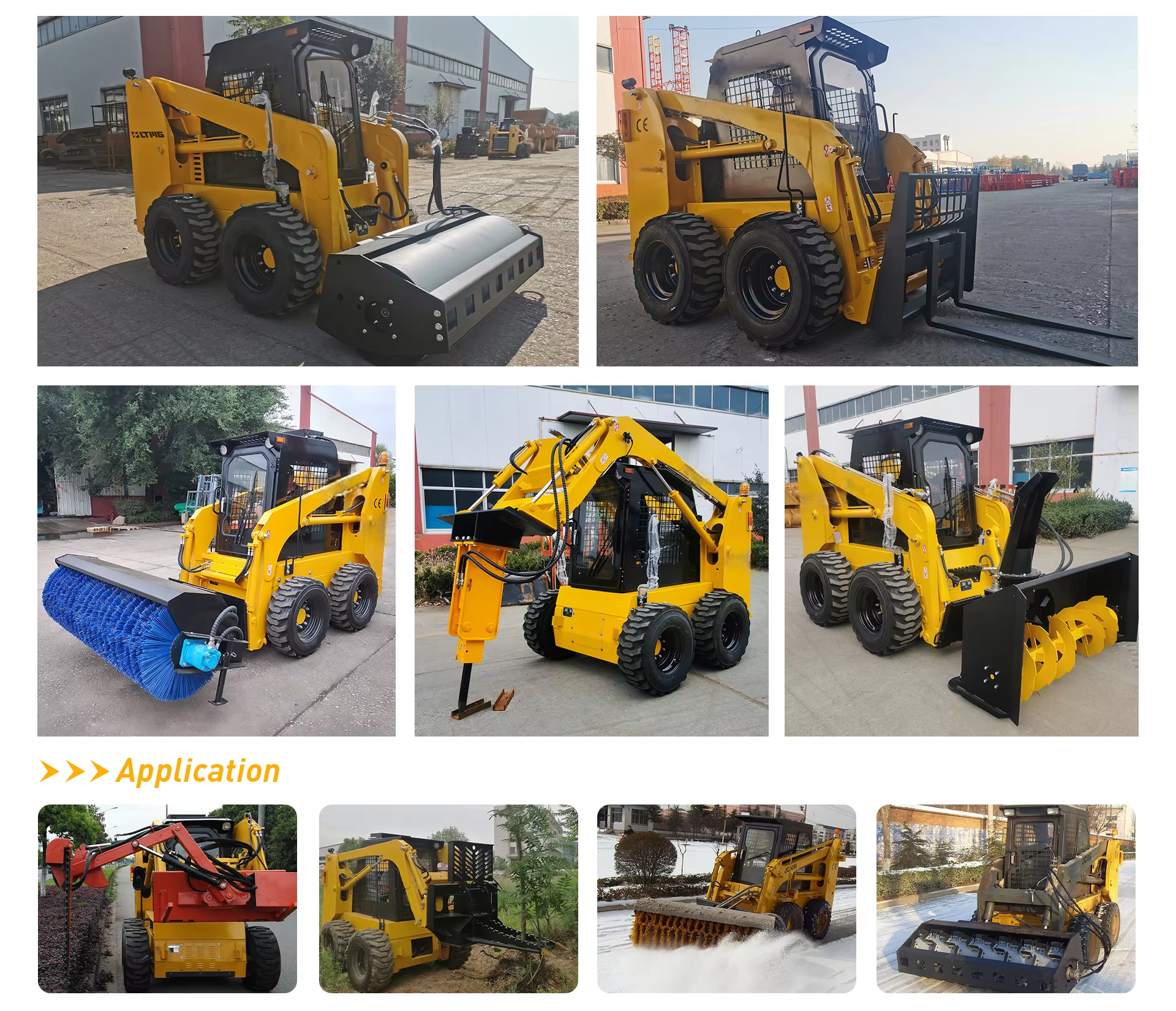
Most of the compatibility question comes down to two things: the mounting plate and the hydraulic flow. This range uses the universal skid steer mount, so the same attachment goes onto a Bobcat, Caterpillar, JCB, New Holland or Kubota loader without an adapter. That interchange matters to a fleet that keeps a mix of wheeled and tracked loaders, or that trades a machine every few seasons.
Every attachment in the range is sized to the carrier class it is meant for. A mini skid steer and a full-size loader do not take the same head, and a tool is matched to the machine's flow class rather than sold on working width alone. The attachments are also built to keep the machine balanced with a load on the front, so a heavy head does not leave the loader nose-light.
Before an order is confirmed, send the loader's brand and model, its hydraulic flow class and the auxiliary coupling type. As a skid steer attachments manufacturer we would rather confirm fitment from the mounting plate dimensions and the hydraulic ports than from a model name that happens to look familiar.
One boundary is worth knowing up front: a high-flow implement only delivers its full output on a machine that supplies high-flow hydraulics. On a standard-flow loader the same tool may still mount and run, but at reduced output. If a heavy planer, mulcher or breaker is on the list, check the loader's flow class first — that is the most common fitment mistake in this category.
| Site or Sector | Typical Attachment Mix |
| Construction and demolition | Bucket, hydraulic hammer, cold planer, grapple |
| Agriculture and livestock | Pallet forks, auger, manure bucket, rake |
| Landscaping and turf | Power rake, auger, stone burier, brush cutter |
| Snow and ice control | Snow pusher, snow blade, angle broom |
| Utility and road maintenance | Trencher, cold planer, closed sweeper, breaker |
| Forestry and land clearing | Forestry mulcher, stump grinder, brush cutter |
| Municipal grounds and parking | Closed sweeper, angle broom, rake, snow blade |
| Rental fleets | One mixed kit matched to the machines on the fleet |
| Look-Alike Pair | What Actually Separates Them | Choose It When |
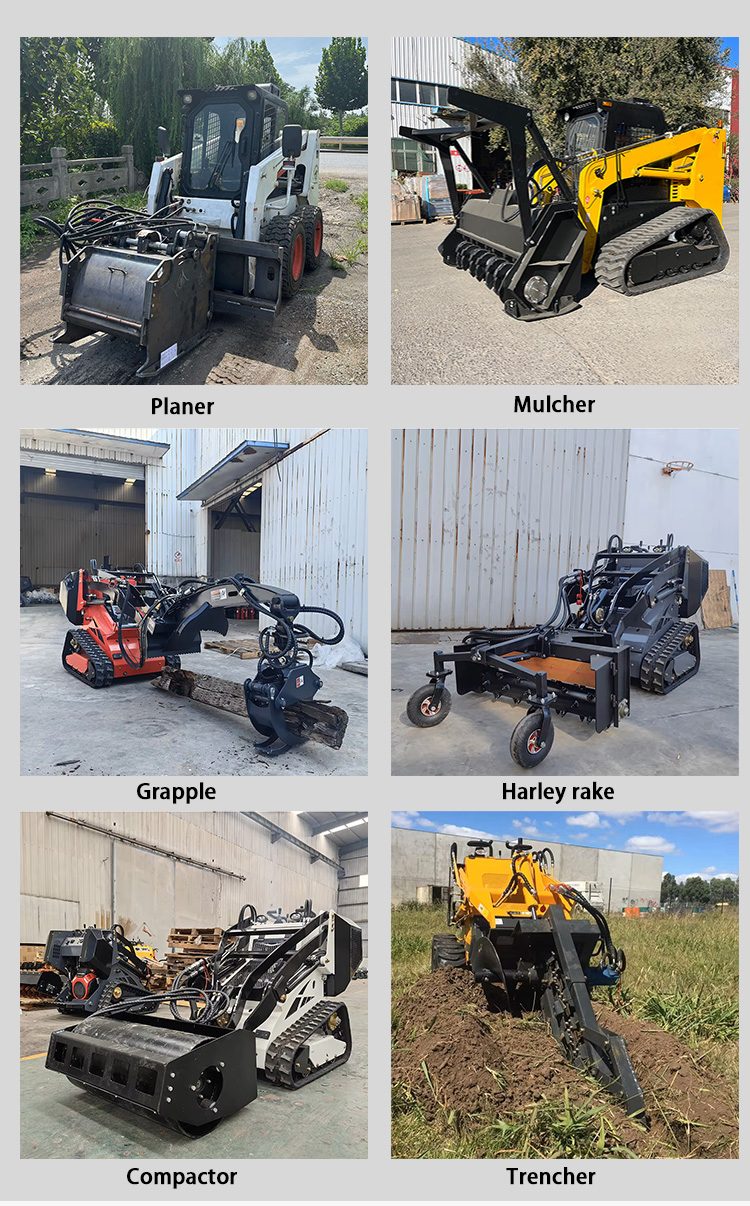
| Cold planer / hydraulic hammer | The planer carries a replaceable tungsten carbide drum and mills to a set depth — 12–40 in cutting widths, up to 6 in (150 mm) per pass — with independent depth and tilt control, so it leaves a level surface behind. The breaker turns the loader's hydraulics into high-frequency piston impacts that fracture concrete, rock, asphalt and frozen soil. | Choose the planer where the pavement stays in place and needs levelling, joint cleanup or a rut removed; choose the breaker where the slab, footing or frozen layer comes out. |
| Closed sweeper / angle broom | The closed sweeper combines sweeping and vacuuming inside a sealed hopper, so dust and debris stay contained on the way to the tip. The angle broom is an open rotating brush with adjustable sweep angle, speed and pressure, built with wear-resistant brush sections for abrasive material. | Choose the closed sweeper where airborne dust is a site or municipal issue and the load has to be collected and carried away; choose the angle broom for fast volume clearing of snow, dirt, leaves and gravel on car parks, roads and yards. |
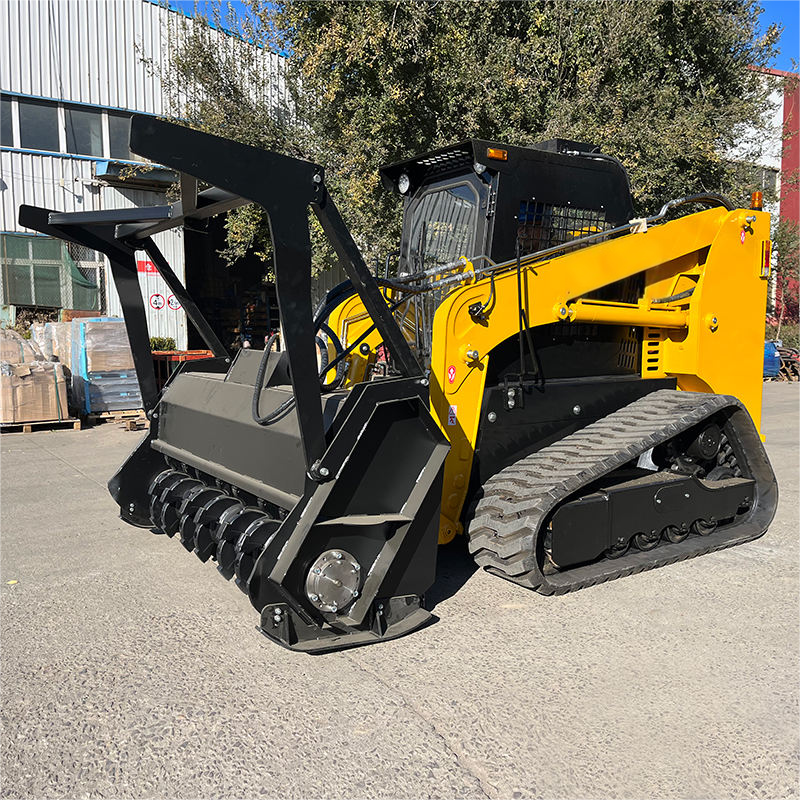
| Width-matched mulcher / heavy-duty forestry mulcher | The width-matched head runs 28–72 in cutting widths, suits a 1–9 t loader and mulches material from 3 in up to 14 in using single-side carbide, reversible carbide or claw teeth on a bent-axis piston motor and synchronous belt drive. The heavy-duty head runs 36–84 in with a Hardox 450 inner liner, drum or disc cutting, trees up to 8 in, SKF spherical bearings and chain guards, in standard-flow 10–30 GPM or high-flow 30–55 GPM versions. | Choose the width-matched head for mixed brush and mid-size stems on the loader you already run; step up to the heavy-duty head for abrasive ground, larger trunks and a high-flow carrier. Both heads are among the larger skid steer attachments, so weigh the loader's rated operating capacity as well as its flow class. |
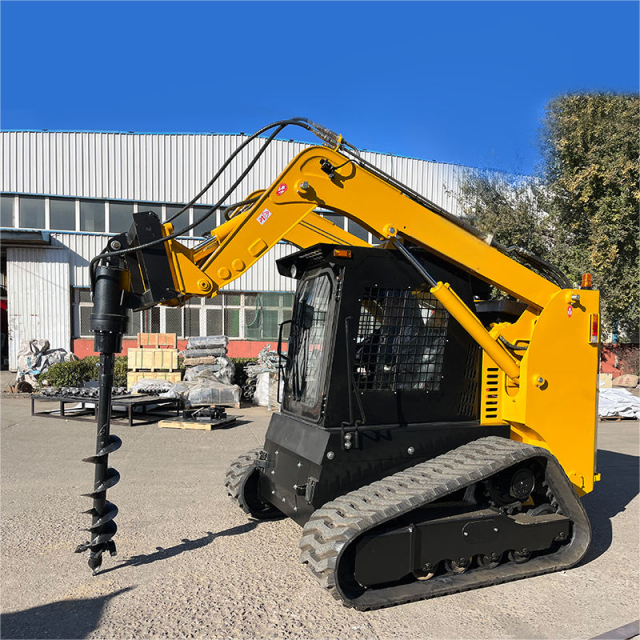
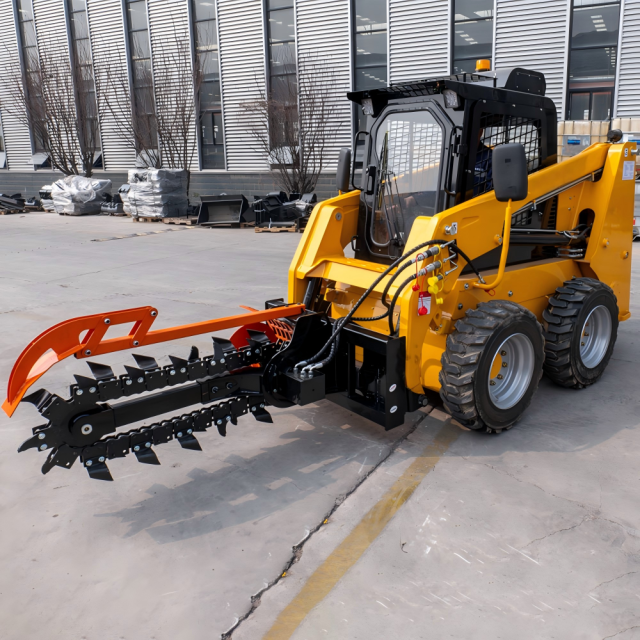
| Auger / trencher | The auger drills discrete holes from 6 to 48 in diameter, with torque options from 815 to 5,000 ft-lb depending on the unit. The trencher cuts a continuous line at 24, 36, 48 or 75 in dig depth in a single pass. | Choose the auger for fence posts, footings, sign posts and tree planting; choose the trencher for irrigation, electrical, fibre and water lines that run along the ground. |
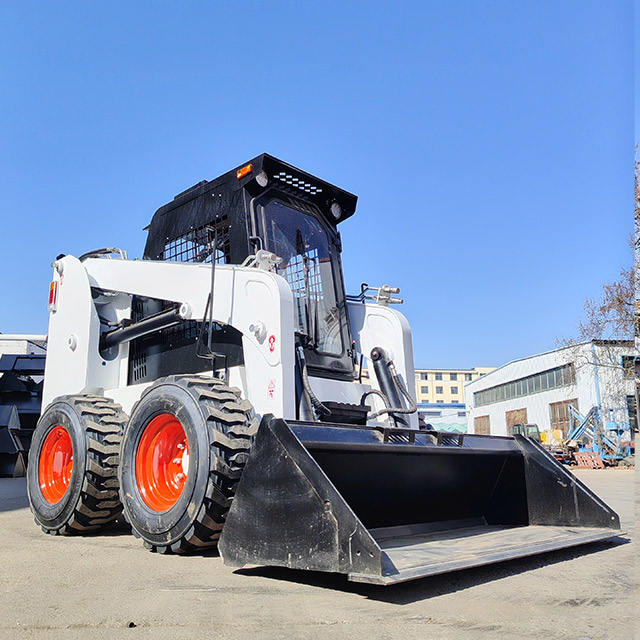
| Bucket / grapple | A bucket scoops and carries loose material — standard, tooth, rock, high-tip and 4-in-1 versions cover feed, gravel, topsoil and broken concrete, and a 4-in-1 clamps and grades as well as it loads. A grapple is built to close on irregular loads such as logs, brush, scrap and demolition debris. | Choose the bucket for anything loose; choose the grapple when the load has to be gripped and placed rather than scooped. |
| Stone burier / rotary tiller | The burier collects stones and debris and buries them up to 150 mm deep while milling and levelling the soil in the same pass, driven by the loader's hydraulics with adjustable working depth. The tiller breaks, mixes and levels soil into a seedbed with high-speed rotating blades, but works the top layer and leaves stones at the surface. | Choose the burier for lawns, turf and green areas where the finish has to be stone-free; choose the tiller where the ground only needs breaking, mixing and preliminary levelling before planting. |
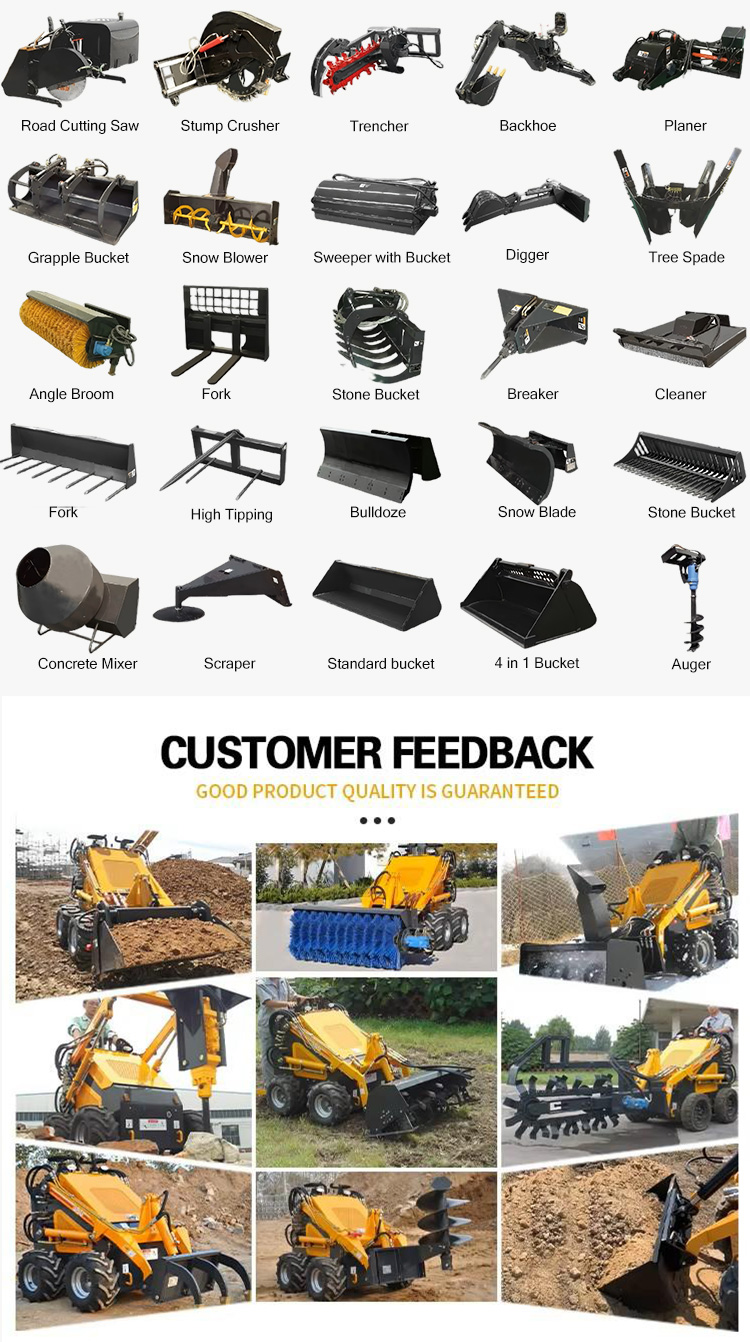
Lovin (Jining Lovin Construction Machinery Co., Ltd.) has supplied machinery buyers since 2017 as a distributor, sourcing through authorised channels and a verified supplier network. One order can cover the machinery mix your customers ask for and leave as a single consolidated shipment. Stocked items dispatch within about 7 days; lead times are confirmed against availability at enquiry, and busy-season schedules are agreed with suppliers in advance. OEM and customised builds follow the same route, and spare and wear parts stay supported after delivery. We export to Europe, South America, the Middle East, Australia, New Zealand and Russia.
Compatibility comes down to what your loader's hydraulics can drive and what its rated operating capacity can carry. Standard-flow machines handle the lighter attachments — buckets, forks, augers, trenchers, brooms and the smaller cutters — while high-flow machines add the heavy implements such as hydraulic hammers, planers and mulcher heads. Above that, capacity decides how large a loaded attachment can be before the machine feels light at the back. Rather than a fixed list, the useful answer is which heads your machine is rated for, and that starts with the loader model.
Yes. Custom work usually starts with the job rather than the catalogue: tell us the task, the material and the loader you run, and the technical team adapts skid loader attachments for construction and agriculture to specialised requirements — the mounting arrangement and the hydraulic side are set up so the tool does what the site actually needs. What changes and what stays standard is confirmed in writing before the order is placed, and the same team supports the attachment after delivery.
It is an operator job, not a workshop job. The loader is parked on level ground with the arms lowered, the attachment is brought level with the mounting plate, the locking levers are engaged on both sides, and the hydraulic couplers are connected with clean hands. From there the tool is run slowly at low engine speed for the first few cycles so any air in the lines is purged and leaks show up before the machine goes to work. No crane, second machine or dealer tooling is needed, and operators who change tools daily build the sequence into their routine. The one habit worth enforcing is a walk-round after mounting: pins fully seated, couplers locked, hoses clear of the wheels.
Less than the machine they hang on. Routine attention goes to two places: the hydraulic connections — clean couplers, no weeping seals, hoses routed clear of pinch points — and the working parts, where teeth, cutting edges and brush sections wear and are replaced as they do. The attachments are laid out so those parts can be reached without dismantling the whole unit. Checks before the first job of the day take a few minutes, and the payback is fewer mid-shift surprises. Sites running abrasive material, such as planing or stump grinding, should check teeth and edges more often than a farm that is moving feed.
They overlap, so match the tool to the material. A brush cutter with a rotating deck is the fast, cost-effective option for grass, saplings and light brush. A forestry mulcher head takes the heavier work — dense scrub, standing trees and regrowth — and leaves a finer mulch behind it. A stump grinder is the specialist for what is left: it grinds individual stumps below grade after the vegetation is cleared, with depth control so the ground can be graded or mown over afterwards. A common kit on a land-clearing job is a mulcher for the bulk of the vegetation and a grinder for the stumps the customer wants gone. As a skid steer attachments manufacturer we match the head to the loader's flow class as well as the material, because an oversized head on a standard-flow machine does not clear faster — it stalls.
Very likely. The universal skid steer plate is a common standard, so most loaders from smaller or regional makers take the same attachments. What we will not do is guess from a brand name that is not on our list: send the mounting plate dimensions and a photo of the plate and the auxiliary hydraulic ports, and fitment is confirmed from those. If your machine uses a mounting system of its own, we will tell you before the order is placed whether it is something we can accommodate.